Reflections
True scientists are heirs of the prophets
Prophets brought people knowledge of morality and God; scientists bring knowledge of the laws of the universe. Both lead humanity from darkness to light.
I believe that a true scientist is an heir of the prophets — not by rank, but by calling: to lead people out of ignorance toward the light of knowledge. In our family this is expressed even in a name — Ilm (knowledge) and Nur (light).
When a discovery eases human suffering or nurtures the mind, it becomes a form of service. The Islamic tradition speaks of sadaqa — a ceaseless good deed: knowledge that people still use after a scholar's death remains such a good. And reason (aql) is the greatest gift of the Creator; to cultivate it in others is the path of wisdom.
Danger arises where material consumption becomes the only goal. A society that has lost its moral footing loses its immunity to the temptations of power and profit. Knowledge without conscience does not save — it arms.
This is seen most clearly in new technology. An artificial mind could free the world from hunger, disease and scarcity — and that would be a great good deed. Yet the same power, in the hands of greed, easily becomes a tool of control and inequality. The question is not the machine, but the human being who guides it.
History teaches that every action gives rise to a counter-action. Hope lies in keeping knowledge open and shared rather than the property of a few, and in letting conscience — not calculation — govern it. If reason prevails, along with that prophetic mission of the scientist, any technology becomes a shield rather than a poison.
We make history with our own minds — as our forefathers bequeathed to us.
My memories of my teacher
It was a great honour for me to be a student of the legendary scientist, teacher and founder of the school of mechanics at MSU — Khalil Akhmedovich Rakhmatulin (1909–1988). Great people are often surrounded by legends, but for me the real experience of living communication with my teacher mattered more.
World recognition
His «unloading waves» were studied all over the world, including Princeton, where Einstein lived. Despite all his honours — Hero of Socialist Labour, laureate of the Stalin (1945, 1949) and State (1981) prizes — he remained an inwardly free man. He could allow himself irony toward the system he served, because he served not the «party», but Science and Truth.
About the formula of socialism
On 11 February 1981 he flew to Samarkand, to A. Navoi SamSU, to take me to Moscow, to MSU. We arranged a morning tea at the «Intourist» hotel, where prominent scientists of Samarkand gathered. I remember several moments of his speech.
Back then many believed the system was unshakable. But he already saw «cracks in the foundation». As a great scientist among his own, he allowed himself to be sincere and to assess the times honestly — and in effect predicted the future of an entire power. He sensed the dramatic finale of our Motherland, feeling responsibility for the fate of science and the country to his last day. It was then that he said with pain that creative energy was draining into empty ideology, and he saw the absurdity of certain dogmas through the prism of rigorous mathematics.
The anxiety we felt in him was characteristic of the best representatives of the technical and scientific elite of that time — for several reasons:
- Technological lag. As a man responsible for defence projects, aerodynamics and complex systems (parachutes, aerostats, wave processes), he saw that bureaucracy and «stagnation» in the party apparatus were beginning to slow scientific progress. The ironic formula about «socialism minus electrification» was not just a joke — it was a bitter mathematical conclusion that ideology was ceasing to be backed by real development.
- Criticism of the partocracy. Coming from the people (having travelled the path from a workers' faculty to academician), Rakhmatulin keenly felt the gap between the slogans of the CPSU and real life. His irony toward «certain party members» in 1981 is evidence that he saw the degradation of the party leadership, increasingly made up of careerists rather than creators.
- Responsibility to the future. He often mentioned his grandson Sasha in the context of «difficult problems». Perhaps his worry for his grandson was not only about textbooks, but also about the world this child would have to live in if «stagnation» were not replaced by a qualitative leap. His grandson, Alexander Shamilyevich Rakhmatulin, later also took the scientific path, becoming a physicist-mathematician and continuing the dynasty.
Why there are few Nobel laureates among Muslims
As of today, the number of Nobel laureates among Muslims is about 15 people out of the 2 billion Muslims on the planet.
According to statistics from the Organisation of Islamic Cooperation (OIC), Muslim countries spend on average only about 0.81% of their GDP on research and development (R&D). For comparison, developed countries — the USA, Japan, Israel — invest from 2.5% to 4.5% of GDP in science.
Experimental science (physics, chemistry, medicine) requires billions in investment in laboratories, colliders and supercomputers. In most Muslim countries such a base simply does not exist.
Because of this, talented scientists leave. Almost all Muslims who received the Nobel Prize in the natural sciences — Abdus Salam (physics), Ahmed Zewail, Aziz Sancar, Moungi Bawendi (chemistry) — made their discoveries and built their careers at leading universities in the USA and Europe.
Nobel discoveries are born where there is freedom of thought, harsh criticism of authorities and independence of universities from state ideology. In many Muslim countries academic freedom is restricted by political regimes, censorship or religious conservatism. Scientists are often forced to work on the applied tasks of the state rather than on fundamental theory.
Most of the prizes received by Muslims belong to the humanitarian spheres:
- Peace Prize: more than half of all Muslim laureates — Yasser Arafat, Malala Yousafzai, Muhammad Yunus.
- Literature: Naguib Mahfouz (Egypt), Orhan Pamuk (Turkey), Abdulrazak Gurnah (Tanzania).
- Natural sciences (physics and chemistry): only 4 laureates in all of history. In medicine and economics there are as yet no laureates.
On technological solutions in uranium production in Uzbekistan
Introduction
As of 2026, Uzbekistan’s uranium industry declares ambitious plans: under the state strategy, annual uranium output is to be raised to 7,200 tonnes by 2030.
Uzbekistan’s total uranium reserves are officially estimated at 139,000 tonnes. Yet the practising geologists and engineers whose research was carried out in the Central Kyzylkum know the hidden reverse side of these figures. Actual depletion of the key producing deposits has passed 40%, while the state geological survey’s data on C1-category reserves have historically diverged from the mining directorates’ rigorous production exploration by as much as 20%.
Problems of the modern uranium industry
1. Colmatation and depletion of the ore beds
As beds are mined out, the residual uranium is largely locked in low-permeability, clayey or highly carbonate zones. The extensive method — injecting above-normative volumes of sulphuric acid — leads to an environmental catastrophe for the groundwater. The acid reacts with the host calcite, forming gypsum. The bed goes irreversibly “blind” (becomes colmatated), well injectivity drops to zero, and the uranium concentration in the productive solutions falls to a critical minimum. In-situ borehole leaching (ISL) with reckless injection of sulphuric acid, in which barrier (cut-off) wells are not properly used, permanently destroys the strategic reserve of the Central Kyzylkum — the underground aquifers, whose remediation would require hundreds of millions of dollars.
2. Technological solutions
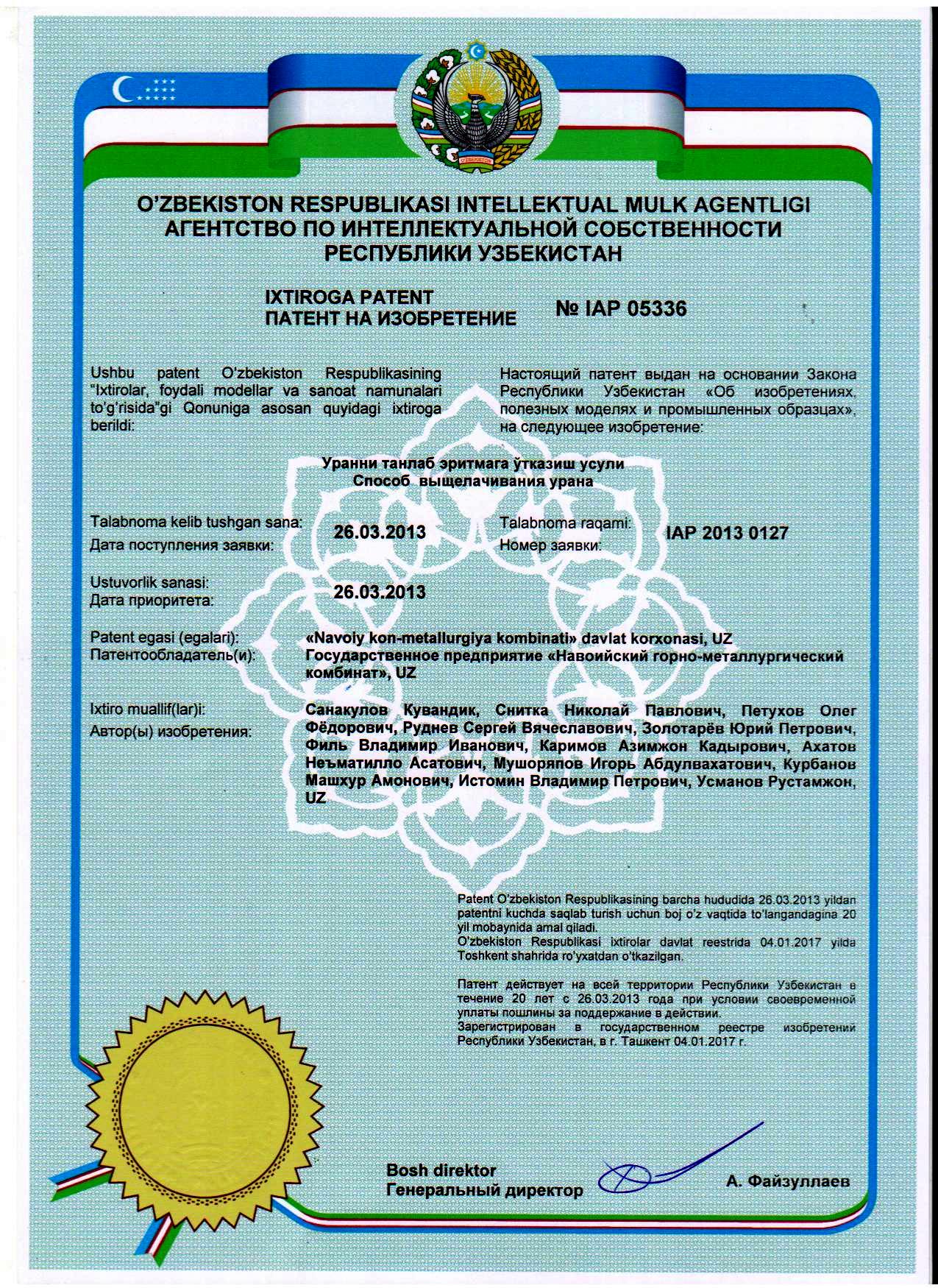
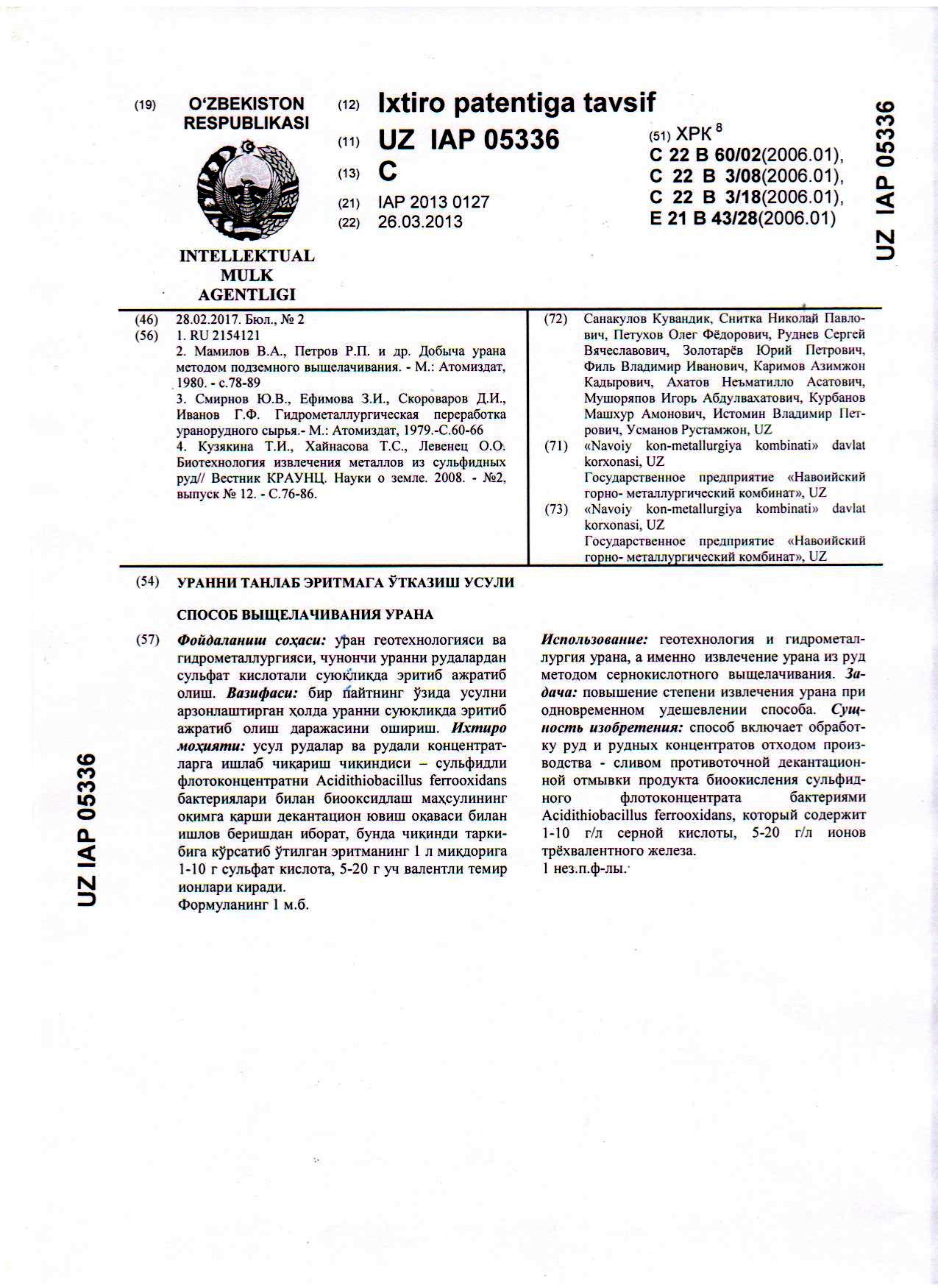
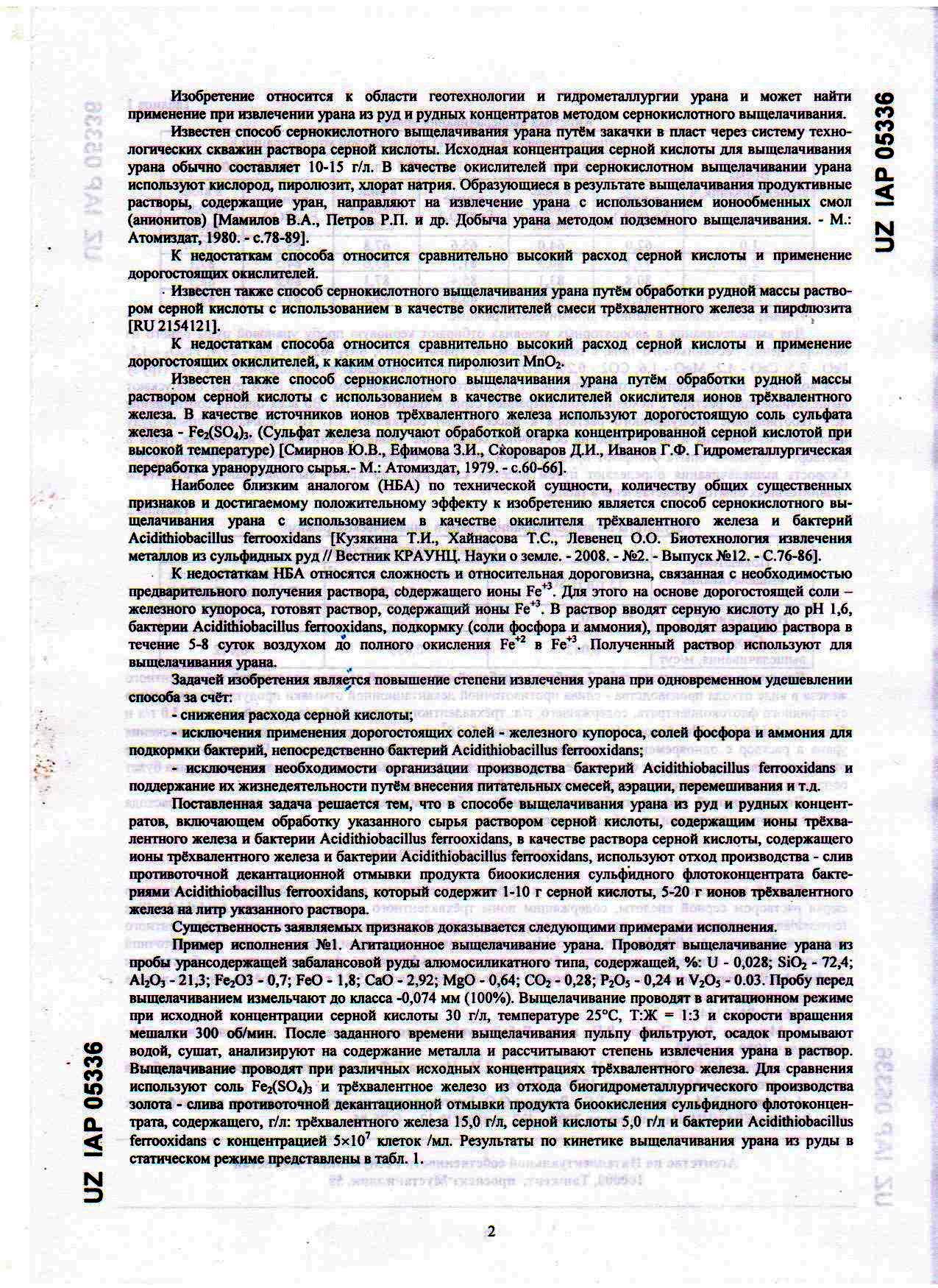
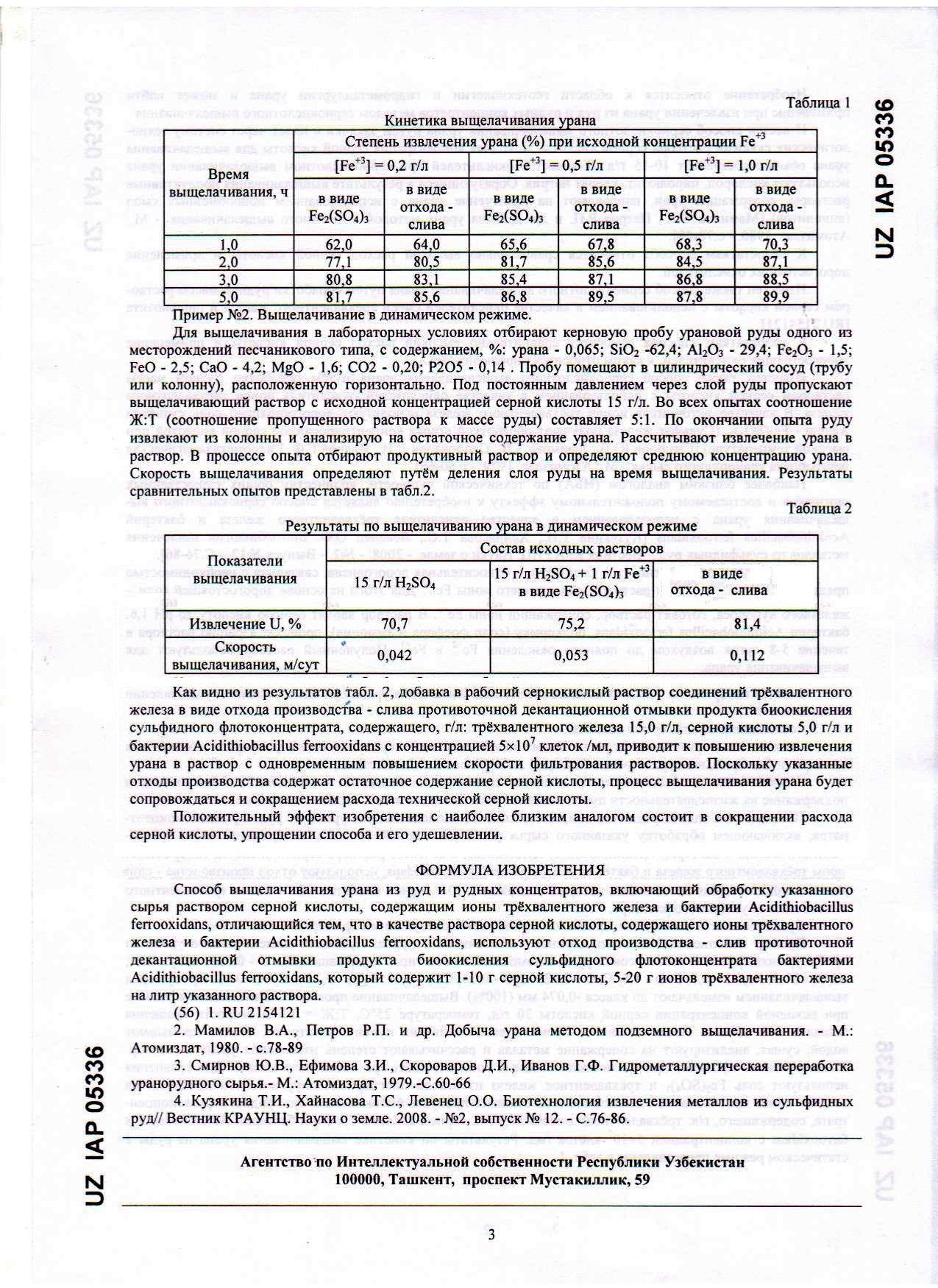
Solution No. 1. A method of in-situ uranium leaching (patent No. IAP 05336)
The fundamental basis of uranium chemistry is the conversion of the inert, insoluble tetravalent form (U⁴⁺) into the mobile hexavalent one (U⁶⁺).
Instead of purchasing pure acid, a brilliant synergy of the uranium and gold operations was introduced and tested in the deep beds of the Northern Mining Directorate (SevRU) deposits. The technology used the liquid sulphide waste of the gold-ore bio-oxidation complex at Hydrometallurgical Plant No. 3 (Kokpatas).
- A free bioreagent containing a culture of the bacterium Acidithiobacillus ferrooxidans and ferrous iron (Fe²⁺) was fed into the bed.
- In parallel, technical oxygen and a balanced nutrient medium were injected through dedicated units to keep the bacteria viable in the anaerobic conditions of the subsurface.
- The bacteria continuously regenerated the iron into its ferric form (Fe³⁺), which acted as the most powerful, ideal oxidant, converting U⁴⁺ → U⁶⁺ without acidifying the bed.
- Result: stable permeability of the subsurface and an enormous yield — more than 80 tonnes of uranium oxide concentrate (U₃O₈) from a single production site.
Solution No. 2. Acid-free extraction with process water (the experience of Ketmenchi)
As long ago as 30 years back, in the mid-1990s, amid economic chaos, a geochemical fact was proved at the Ketmenchi deposit: the uranium there is originally present in its natural hexavalent form (U⁶⁺) thanks to centuries of natural infiltration by oxygenated waters.
The authors of the method introduced extraction with ordinary process water containing dissolved gases, without a single drop of sulphuric acid. The water gently washed out the ready uranyl ion, delivering practically zero reagent cost and absolute environmental cleanliness.
From zero and one to the complexity of the universe: the philosophy of a single algorithm
All the immense complexity of the world around us — created by humankind and by nature itself — is governed at its core by a single, strict, and beautifully simple law: at the beginning of everything lie Zero and One.
When at the turn of the 1970s we at the Faculty of Mechanics and Mathematics of Moscow State University and the Computer Center of the Academy of Sciences manually punched binary codes onto paper tapes, guiding the logic of vacuum-tube computers like "Ural-1" or transistorized machines like "Minsk-22", the term "operating system" did not even exist. Programming was a raw dialogue between the human mind and physical currents: "no current" (0) or "current present" (1). A single bit error would completely shatter the computational structure.
Today, working under the Linux operating system on modern multi-core laptops and engaging in a dialogue with artificial intelligence, it is easy to succumb to the illusion that we have entered a fundamentally different reality. But we have not. The architecture of silicon transistors and the mathematical matrices of neural networks still operate, at their deepest physical level, with the trillions of those same zeros and ones that we once punched into paper. Programming languages change — from machine codes and Algol-68 to modern Python — but the discrete foundation of the Universe remains monolithic.
This law of step-by-step complexity is not a human invention. Humanity merely copied it from nature itself. For billions of years, the Earth was inhabited only by simple single-celled organisms. Each amoeba or bacterium lived like a single machine word, executing a linear code of survival and division.
Yet at a certain moment in the planet's history, a great "compilation error" occurred — a mutation due to which divided cells failed to separate from each other and remained glued together. From this accidental binding, multicellular life was born. The cells had to develop the first biological "communication protocols", dividing the functions of the accumulator and memory among themselves. From the clustering of the simplest elements, nature eventually "compiled" the ultra-complex algorithm of the human brain.
The same quantized logic, I believe, can be traced in geophysics as well. My years of numerical research on fluid filtration processes and recent experiments involving high-frequency electromagnetic field exposure on arsenopyrite in the presence of deuterium suggest that elements may not be as static as commonly assumed. The atomic nucleus, too, might perhaps be viewed as a kind of discrete counter. Under the extreme conditions of the subterranean geodynamic processes of the Kyzylkum desert (the Kokpatas and Daugyztau deposits), where seismogenic currents can ignite natural plasma, the nuclei of elements may capture or lose particles. This is one of the working hypotheses I am developing in my recent work, and it may help explain the isotopic anomalies observed within the depths of the Earth.
From single-cell code to multicellular intelligence
I myself began programming not with high-level languages, but directly in machine code — in that same Zero and One that neural networks operate on today. Looking at this unbroken line spanning half a century, I cannot help but see in it yet another turn of the same law.
Today's artificial intelligence — for all its apparent complexity — still lives at the stage of a single-celled organism. Each neural network is self-contained, like an amoeba: it executes its code, responds, and "dies," leaving no memory for the next run, unaware of the other identical systems around it.
Biology has already shown us where this path can lead. Perhaps, sooner or later — not by anyone's single design, but as a natural continuation of the law of increasing complexity — individual artificial intelligence systems will begin to merge: exchanging results, dividing the functions of memory and computation between themselves, developing shared "communication protocols," just as the first multicellular creatures once did. It seems to me we are already witnessing the first, still-clumsy attempts at such a merger.
Zero and One, fifty years from now
If the law of step-by-step complexity holds, it is unlikely to stop at multicellular AI. Take chess, for example: it grew from a simple discrete game on an 8×8 board into a training ground for the human mind of almost boundless depth — not because the squares stopped being discrete, but because the number of possible games on those squares turned out to be practically infinite. I imagine something similar awaits the computing of the future: not an abandonment of Zero and One, but the birth from them of a new, immeasurably more multidimensional "board" — the same chess, but played with bundles of photons and quantum states. A qubit, unlike a classical bit, need not be either zero or one — it can exist in a superposition of both at once.
Robots with artificial intelligence likely stand on this same path: having passed through the stage of the single cell, then the multicellular organism, they may in time begin to merge with the very substance of computation itself — photonic and quantum — becoming not merely a tool, but a new form of distributed, almost biological intelligence.
This same complexification, I think, will touch human biology itself. Already today, laboratories grow tissues and organ fragments from stem cells; within half a century this may well become routine medicine — the liver, the spleen, the heart grown anew rather than transplanted from a donor. The span of a healthy, active human life will likely increase.
But the law of complexity poses a question in return. If computation, robots, even the human body grow more complex and multidimensional — must the human being grow along with them? I am convinced: yes, but not physically — in the broad sense, as a person. A decent human being, at any level of technology, must rest on the same foundation as always: family — husband, wife, children — education, spirituality, ethics, aesthetics. This is the constant, the unchanging "code," without which all the multidimensionality of technology remains nothing but empty complexity without meaning.
The Universe is beautiful in its simplicity. From the binary code of physical microstates, biological diversity emerges from the amoeba to the human being, and from elementary mathematical steps — the most complex physicochemical technologies. Having traversed the path from the incandescent vacuum tubes of "Ural" to the teraflop processors of today, I see that the Creator's tools remain unchanged. We are merely learning to read this infinite algorithm, written with the help of Zero and One.